The true costs of moving homes in 2026, how you can mitigate them, and why it might be worth it to move anyways (from an advice-only planning firm owner who recently moved despite the cost).

After a few years of deep reflection my family relocated to Waterloo Ontario this summer. Now that we’ve recovered from the logistics of the move itself (not to be underestimated!), I wanted to share some of the financial planning related thoughts that surfaced during this period of transition.
First, good financial planning is aligning your finances to enable the life you want to live.
Where you choose to live is one of life’s biggest financial and life decisions and worth careful consideration. There’s been some excellent work in the planning community recently on the decision to rent vs. buy: Ben Felix: Renting vs. Buying The Reckoning. My take is that renting isn’t “throwing money away”, but I also believe that suitable rental options aren’t always available, especially for families.
The focus of this post will be for current homeowners who are considering selling and then buying a new home (or buying their first home), however I do want to acknowledge that in many parts of Canada homeownership has become very challenging for average income earners.
Moving is incredibly expensive! It’s worthwhile deeply reflecting on why you want to move and what you will gain from it before pulling the trigger. For many the process of moving gets wrapped up in mortgages and a bunch of successive and emotionally charged transactions that “all come out in the wash” … but the costs are real.
Based on some worked examples here I estimate Canadians spend between 5% to over 10% of the value of their home each time they decide to move. That was not great when home prices were more reasonable, but can be financially devastating now that many homes are over a million dollars in places like the GTA and Vancouver. There are plenty of non-financial reasons to move, our family is very happy with our move, but we went in eyes wide open to the costs of moving and did our best to mitigate them along the way.
My hope is that by shedding some more light with some illustrative numbers others can reflect more deeply before purchasing a home or in their moving decision process, and hopefully save some money along the way.
I’ll illustrate through two example families making very similar moves but with very different costs.
Let’s start with family A the Apple household.
They have young children and own a $1M home in a Toronto suburb and are fortunate to have a mortgage of “only” 500K at a 4% variable rate. Their parents live in a town 70km away and they decide they’d rather move closer to them. It’s June, their eldest is about to start school so they really want to get settled before September. They decide to move to another $1M house, same price similar mortgage right? Unfortunately, the Apples now need to spend $110,000 out of their pockets or increase their mortgage to 610K to complete the transaction. How could that be?
First, the Apple’s had to move in a hurry. Unfortunately they didn’t have time to put a fresh paint coat on the home, nor were they in a good position to negotiate their new home purchase and sale price. Let’s conservatively assume their home sold for 20K less than it’s fair value. They also paid a full 5% real estate commission plus sales tax for a whopping ~55K. Ontario land transfer taxes added another ~17K. They were forced to break their existing mortgage and incur a 5K penalty (often much more). Finally they incurred another 13k in closing costs like including legal fees, prepping their current home, home inspections, repairs on both homes (when the home inspections inevitably find something), moving trucks, and minor furnishing changes, admin & setup fees etc.
All of a sudden with reasonable assumptions they reach a totally unreasonable $110,000 cost of moving (or 11% of their home value).
Now the Apples may well still decide to move even, but for that kind of money they could have built an in-law suite or taken many years for family vacations with Grandma & Grandpa for a similar price (and I think it’s worth at least reflecting on those options).
Ok now let’s consider family B, the Banana’s. They also have young children and own a $1M home in a Toronto suburb and are fortunate to have a mortgage of “only” 500K at a 4% variable rate. They are also moving to a new town 60km away. They’ve been planning their move for a while, Mrs. Banana was was even able to get a new job closer to their intended moving destination.
With some planning & negotiation the clever Banana family was able to manage a nearly identical move to cost about 55K or half as much, wow!
Instead of a 5% sales commission the Banana’s negotiated 4.5% with their selling agent and agreed to buy with an agent they were referred to. The Banana’s also asked their buyers agent for a partial commission rebate of 0.5% upon a successful purchase. These quick but awkward conversations saved the banana family over 10K. All figures are illustrative and vary by local market.
Because they were planning their move in advance they did spend 2K more on a fresh paint job and some minor home prep. However, we’ll assume they were able to sell their home for 20K more (or buy their new home for 20k less) as they could show well and negotiate offers from a position of strength.
The clever Banana family had made sure that their original mortgage was “portable”. A portable mortgage is one that can be transferred to a new property with identical terms incurring a few hundred dollars of admin fees vs. thousands in break fees. This meant that they saved about $5K in mortgage break fees.
Finally Mrs. Banana is moving more than 40km closer to her new place of employment. As a result she may meet the CRA’s criteria for a moving expense tax deduction. If so many of her biggest moving expenses (including commission & land transfer tax) become a tax deduction from her income earned in her new location. Depending on her tax bracket and the timing of the move a ~65K deduction this could be worth ~15-30K+ in personal income taxes saved. Please note the CRA is highly likely to audit moving expense deductions and so you should document and review carefully with an accountant.
For those of you asking for a more simple line by line comparison here it is:
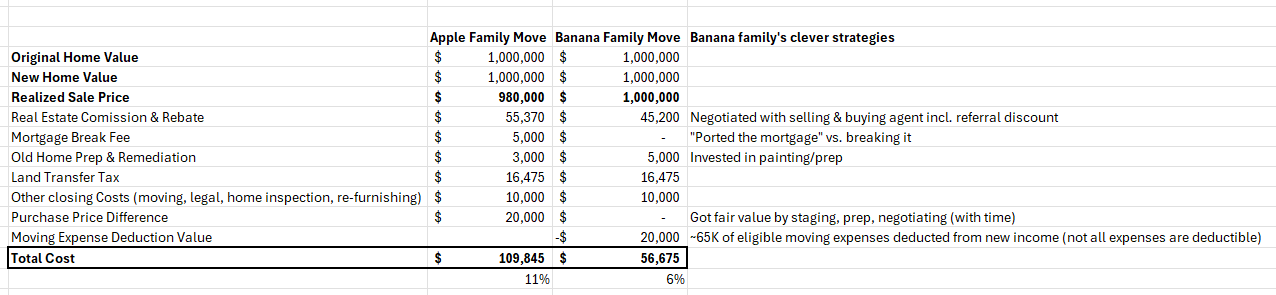
Moving cost illustrative comparison